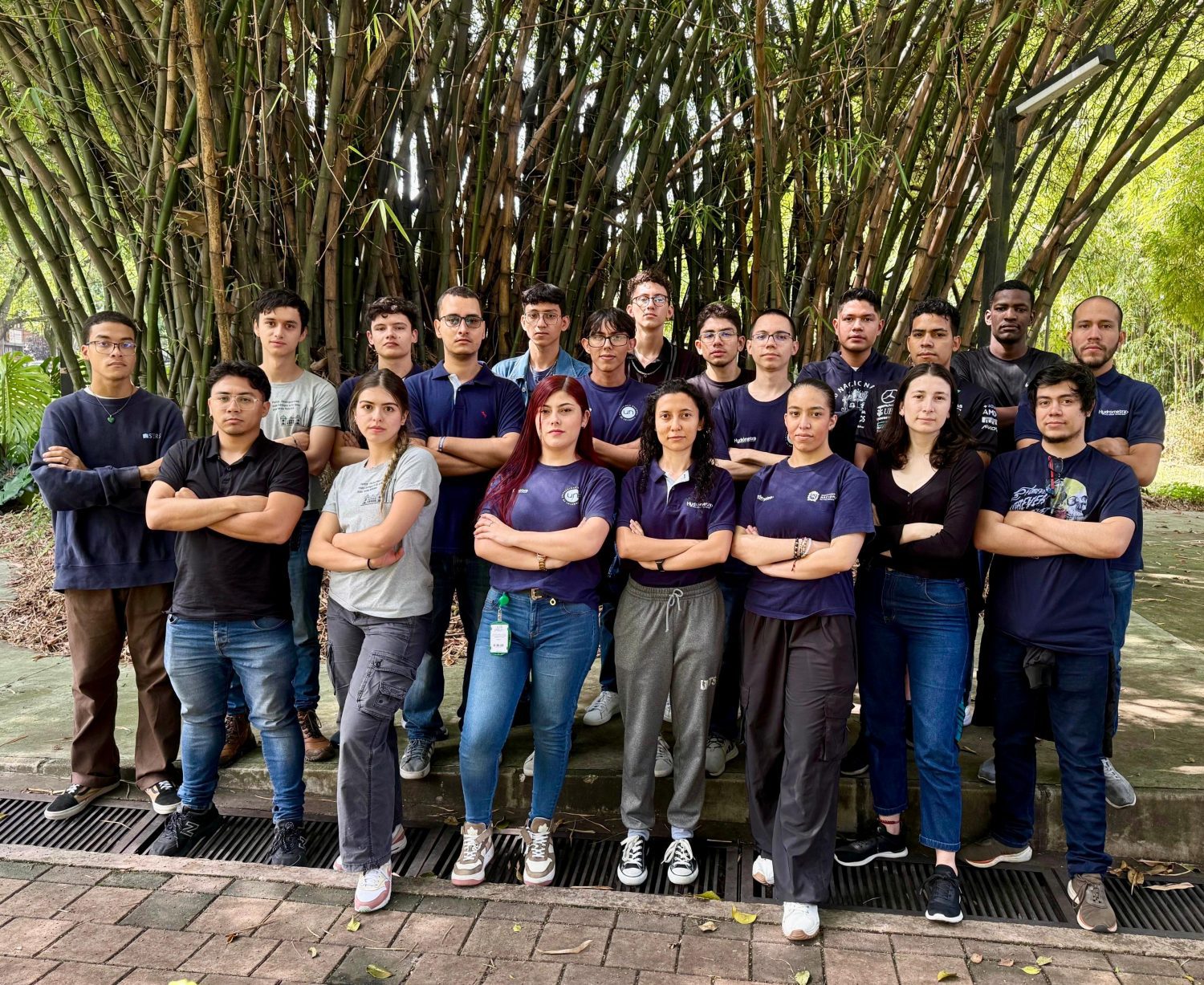
Each week, Jeune Marine highlights one of the student teams competing in HydroContest by ENSM, the international challenge that invites future engineers to rethink maritime energy efficiency. This week, we head to Colombia to meet Hydrómetra, a team from the Universidad Nacional de Colombia, competing in the Design Challenge. The team answered our questions to help us better understand their project, their journey, and the people behind it.
Who is Hydrómetra and why HydroContest?
Hydrómetra is an interdisciplinary student team dedicated to the design and manufacturing of electric maritime vehicles. The team brings together students from civil, mechanical, electrical, control, physics, and systems engineering backgrounds.
Their organization mirrors that of a professional engineering firm. The Fluid Dynamics team focuses on hull optimization through computational fluid dynamics simulations. The Mechanical Design and Manufacturing team develops composite structures, including carbon fiber components. The Electrical & Control team integrates the motor, battery management system, sensors, and real-time data acquisition. Meanwhile, Logistics & Project Management oversees budgeting, sponsorship, shipping, and international coordination.
Their motivation is driven by three main goals:
- representing Colombia in an international maritime engineering competition,
- promoting energy efficiency and sustainable mobility in the naval sector,
- and transforming theoretical knowledge into a real-world prototype with measurable performance.
What inspired their design?
In the Design Challenge, propulsion is identical for all teams, making hull design a decisive factor in performance.
Hydrómetra builds on experience gained in previous editions of the competition. Over time, the team has developed a strong conceptual background in hydrodynamic efficiency, particularly around inverted bows, slender hull geometries, and drag reduction strategies.
However, each edition brings new technical constraints. The current prototype adapts those established principles to meet this year’s specific requirements, while maintaining the team’s identity and focus on efficiency.
For Hydrómetra, design is not about appearance — it is about performance.
Did they face challenges during development?
Absolutely. The initial concept underwent multiple revisions. The team followed a spiral design process: simulate, build, test, adjust, and repeat. The arms connecting the hulls were redesigned several times to improve structural rigidity while minimizing added weight. The motor position was reconsidered, and the propeller configuration refined to optimize thrust and overall hydrodynamic efficiency.
Each iteration was guided by simulation results, manufacturing constraints, and experimental testing. In the end, these adjustments significantly strengthened the prototype and improved its performance compared to the first design.
What are their expectations for the event?
For Hydrómetra, HydroContest is much more than a competition.
On a personal level, the team looks forward to cultural exchange with students from around the world and to networking with maritime professionals and industry representatives. Exposure to innovative sustainable maritime technologies is also a key expectation.
Professionally, they aim to validate their hydrodynamic simulations with real competition data, present their project to potential sponsors and academic collaborators, and reinforce their profile as future engineers committed to the energy transition.
This experience represents an important milestone in their academic and professional development.
A memorable anecdote?
Among many stories from the project, one lake test stands out.
The team needed to compare the current displayed on their onboard control system with readings from a clamp meter. The challenge was that the clamp meter could not be read from the shore.
So they improvised. One team member boarded a small boat, held onto the stern of the operating prototype, and dictated the clamp meter readings in real time.
Unexpectedly, the prototype began towing the small boat — with two people on board. Although the setup was quickly improved for safety in future tests, the moment revealed something remarkable: the prototype’s drag was low enough to generate sufficient thrust to pull another boat.
Creative problem-solving, teamwork under pressure, and learning through real-world experimentation — that is the Hydrómetra spirit.
With technical rigor, international ambition, and a clear commitment to sustainable mobility, Hydrómetra fully embodies the spirit of the Design Challenge