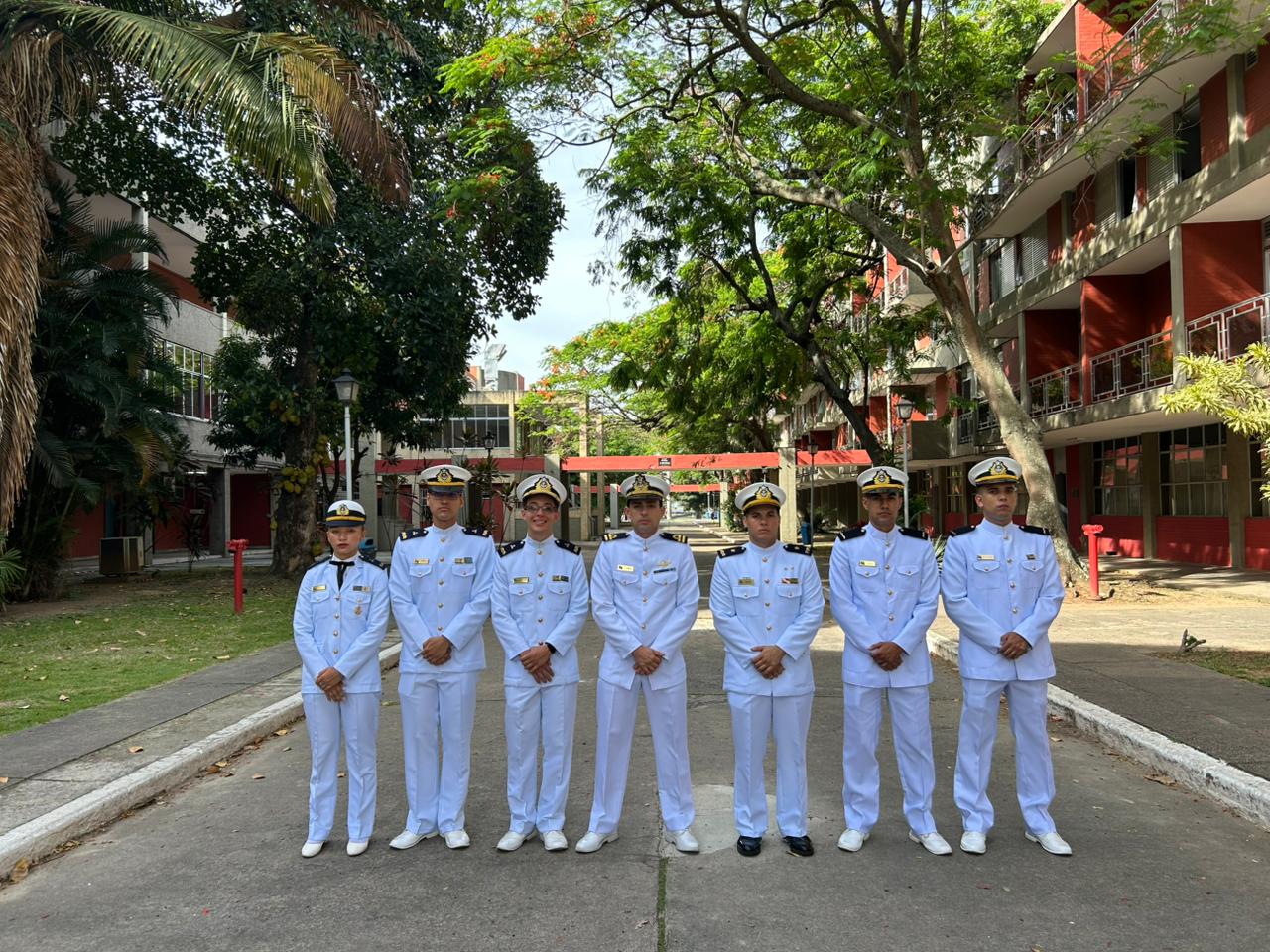
As part of this week’s team spotlight, we travel to Brazil to meet Team ECONAUTICA, competing in the Retrofit category of the HYDROCONTEST BY ENSM . Composed of students from the EFOMM, the team brings together diverse expertise and a shared ambition: to contribute to a more sustainable maritime industry through practical and innovative solutions.
Team Introduction: Composition, Roles, and Motivation
Team Econautica is composed of ten students from EFOMM, bringing together complementary backgrounds from both nautical and mechanical programs. This diversity enabled the team to form a well-balanced, cohesive, and highly productive working group.
Although still in training and without direct professional experience in the maritime industry, the team benefits from an academic curriculum strongly oriented toward real ship operations. This provided a solid and practical foundation for tackling the challenge.
The team leader, Bezerra, a nautical student, was responsible for coordination, workflow management, and ensuring alignment across all members, while also contributing operational and navigation insights. Cunha, also from the nautical field, brought additional expertise in electrical engineering, playing a key role in researching innovative technologies and exploring potential applications of Artificial Intelligence.
From the mechanical side, Maia and Ingrid focused on international conventions and regulatory frameworks impacting feasibility. João Souza worked on propulsion systems, particularly turbine behavior and main engine optimization. Fontes, Antonio Silva, and Gabriel Pereira concentrated on alternative fuels, especially biodiesel and its onboard applicability. Finally, Isaac Truvilho and Lázaro explored unconventional and emerging solutions to ensure the proposal remained innovative and forward-thinking.
The team’s motivation stems from a strong desire to bridge theory and practice. As future maritime professionals, they recognize the importance of improving the efficiency and sustainability of the existing fleet. The retrofit approach is especially meaningful, as it reflects real-world challenges they are likely to encounter in their careers.
Participating in the HYDROCONTEST BY ENSM allowed them to apply academic knowledge in a realistic context, develop critical thinking, and deepen their understanding of the technical, operational, and environmental aspects of modern shipping. It also represents an opportunity to engage with the international maritime community and actively contribute, even as students, to the transition toward a more sustainable industry.
Approach to the Retrofit Challenge
Working within the constraints of an existing vessel proved to be one of the most challenging aspects of the project. The team frequently explored promising ideas that initially appeared effective but later proved incompatible with technical, operational, or regulatory limitations.
Rather than being discouraging, this iterative process made their work more realistic and strengthened their commitment to identifying truly viable solutions.
To address the problem effectively, the team adopted a structured, data-driven approach. They began by identifying the main contributors to fuel consumption, conducting a detailed analysis of the vessel’s operational profile, including route characteristics, speed patterns, and energy demand.
A key finding was the mismatch between the vessel’s design speed and its actual operating speed, highlighting inefficiencies in engine loading and propulsion performance. This insight suggested that optimization could be achieved without major structural modifications.
Additionally, the team analyzed environmental conditions along the vessel’s route and identified complex and variable weather patterns. This opened opportunities for optimization through improved operational planning.
These findings allowed them to define the most relevant transformation levers, prioritizing solutions that directly address operational inefficiencies while remaining feasible within a real-world retrofit framework.
Challenges and Reconsiderations
The team encountered several difficulties and had to reconsider multiple initial assumptions throughout the project. A significant portion of their work was ultimately discarded after careful evaluation.
Many ideas proved economically unfeasible, too complex to implement under the given constraints, or insufficient in terms of reducing fuel consumption and emissions. This led the team to continuously refine their approach.
The requirement to avoid dry-docking and rely exclusively on onboard implementation significantly narrowed the range of viable solutions, pushing them toward more practical and adaptable alternatives.
This iterative process became a core part of their methodology. The effort invested in discarded ideas helped deepen their understanding of the vessel and the problem, enabling them to progressively eliminate less effective options and converge toward solutions that are both feasible and impactful.
The final proposal is therefore the result of a rigorous selection process, grounded in real-world feasibility and continuous learning.
Expectations and a Memorable Experience
 For Team ECONAUTICA, HYDROCONTEST BY ENSM represents far more than a technical competition. It is a human adventure centered on collaboration, knowledge sharing, and exchange with students, mentors, and maritime professionals from around the world.
On a personal level, the team hopes to gain new perspectives beyond their academic environment. Professionally, they see the event as a bridge between theory and real-world application, allowing them to better understand how innovative solutions are evaluated in practice—not only technically, but also in terms of feasibility, cost, and operational impact.
One particularly memorable moment occurred during the final weekend before submission. After revisiting their calculations with greater rigor, the team realized they had overestimated the impact of their solutions on fuel consumption.
This critical discovery forced them to reassess their entire approach under significant time pressure. In response, the team worked intensively throughout the weekend, reviewing assumptions, refining models, and strengthening the consistency of their proposal.
Despite the pressure, this moment became a turning point. It reinforced the importance of accurate modeling and critical validation, ultimately enabling the team to deliver a more realistic, credible, and technically robust final proposal.
Team Econautica’s journey in the HydroContest by ENSM perfectly illustrates the spirit of the competition: combining technical rigor, adaptability, and collaboration to address real-world maritime challenges.